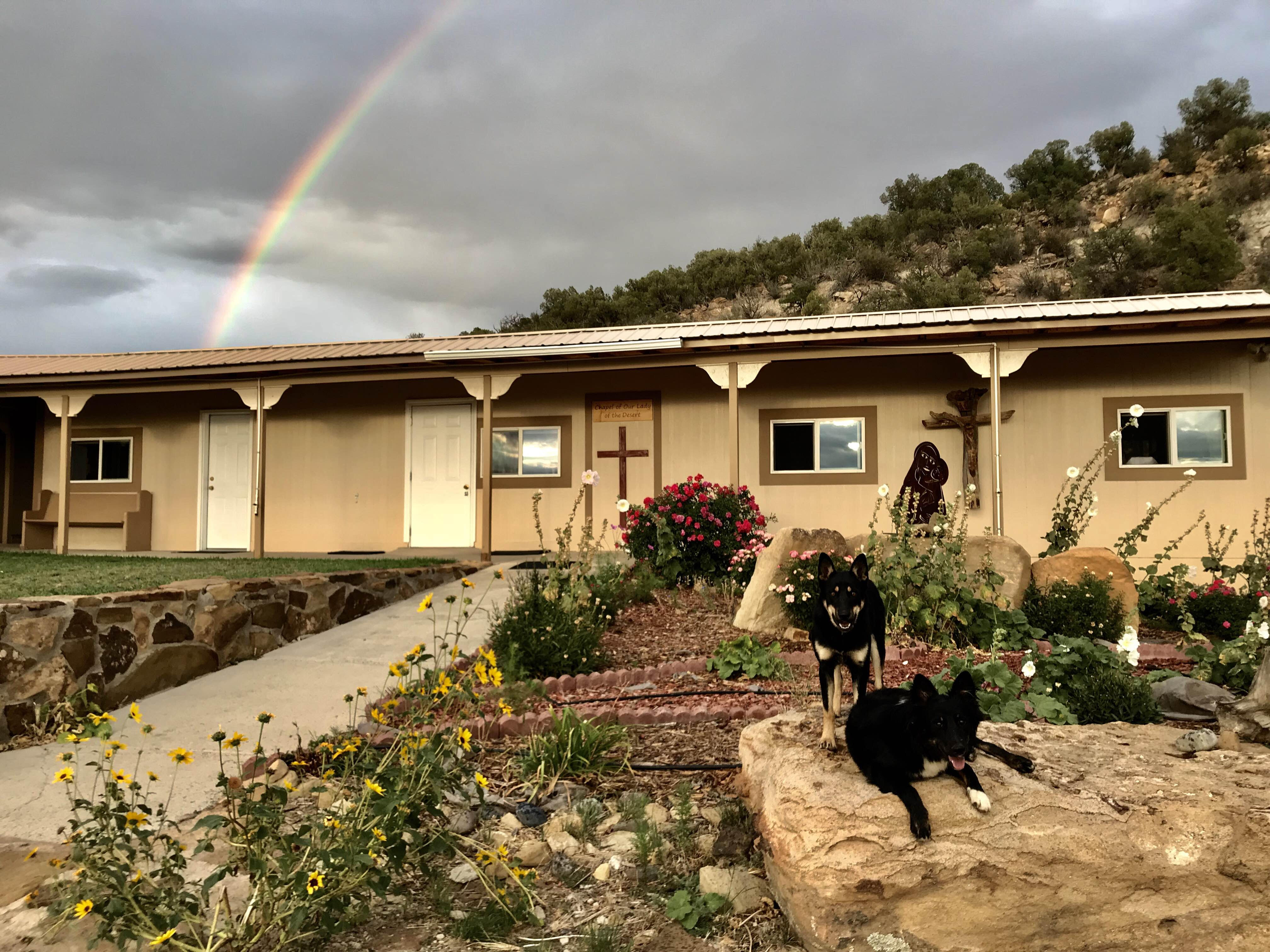

Chapel

Chapel before the renovation

Thanks to the many workers

Outside of the Chapel

Tabernacle area of the Chapel

Dear old St. Joseph

Brother Francis Martinez, a monk from the Monastery of Christ in the Desert, recently spent one week as a guest June 2010, touching up the statue including sculpturing the hands.  Besides cleaning, and repairing shattered nicks and pieces, Brother Francis took the time to rebuild and repaint.

DIVINE OFFICE

We fulfill this sacred number of seven if we satisfy our obligations of singing at Vigils, Lauds, Terce, Middle Hour of Sext, None, Vespers, and Compline, for it was of these hours during the day that the Prophet said, Seven times a day I praise You (Ps118[119]:164). Besides the Angelus, a nun rings the bell seven times a day 7 minutes before each prayer in the Church.

Rule of St. Benedict, CHAPTER XI, The Celebration of Vigils on Sunday…In Verse 8, “After the fourth responsorial, the abbot begins the hymn ‘We praise you, God.” When that is finished, he reads from the Gospels while all the monks stand with respect and awe.”

The Sound of Music by Br. Vincent (quoted with permission from the author)

St. Mary’s Monastery
171 North Main St.
Petersham, MA 01366-0345

We all know the song “Do-Re-Mi” from the 1959 Rodgers and Hammerstein musical The Sound of Music. The song uses the familiar names for the musical scale we all learned as children: Do, a deer, a female deer, re, a drop of golden sun, etc. Ever wonder where these names came from? Well, they are the invention of the Benedictine monk Guido of Arezzo, born near Paris around the year 995. He became a monk in the monastery of St. Maur des Fosses, France, where Guido faced head-on a widespread problem in the Church: Gregorian chant was taught and spread only orally with much difficulty. With no adequate musical notation in existence and an ever-expanding repertoire it was impossible to keep the chants standardized.

Statue of Guido in Arezzo

This led him to invent a four line musical staffwhich graphically represented the different pitches of the scale. Originally, the notes went as follows: ut, re, mi, fa, sol, la, si. The names were taken from the first verse of the hymn Ut queant laxis, which was written by Paulus Diaconus in the 8th century. This hymn was sung back then as it still is today in monasteries including our own, at 1st and 2nd Vespers of June 24, the Solemnity of the Birth of St. John the Baptist. The notes are where the sounds fell on the scale in the hymn:

Ut queant laxis resonare fibris

Mira gestorum famuli tuorum,

Solve polluti labii reatum,

Sancte Iohannes.

[Translation: Remove the guilt of defiled lips so that your servants can, with all their voices, sing of your wonderful feats, O Saint John!]

An example of chant notation before Guido

A manuscript using Guido's notation

For the English-speaking world, at some point “ut”, “sol”, and “si” were changed to “do”, “so”, and “ti” respectively (much to the delight of Rodgers and Hammerstein). But the original three remain in the Romance languages. For example, in French a symphony in the key of C major would be “symphonie ut majeur”.

Guido’s efforts to introduce his new system of notation upset many of his brethren so much he was sent off to the monastery of Pomposa near Ferrara, Italy. He was treated even worse there and sought refuge in the town of Arezzo, which had no monastery, but which did have a large group of singers needing training. His new method proved so successful his fame spread widely and Pope John XIX (1024-1032) urged Guido to come to Rome and implement his system for the Church there. However, the Roman climate made him sick, and he had to return to Pomposa, where his once hostile brethren, truly repentant, welcomed him back warmly and desired to have him stay, but he returned to Arezzo shortly thereafter. He died around 1050.

Guido’s invention paved the way for the modern musical scale. He is thus universally recognized for his services to the progress of musical art and science, and his memory is sure to live on. Recently, when various experts designed a new music notation system to be readable both by computers and humans, it was named GUIDO Music Notation in his honor.